|
 |
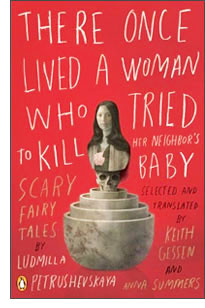
09-04-09: 'There Once Lived A Woman Who Tried To Kill Her Neighbor's Baby' : From Russia, With Fear by Ludmilla Petrushevskaya
There's a certain tone that one finds in the best folk tales, a stone-cold vision of the stark unreality that underlies and permeates our lives. In glossy, glittery America, writers have a hard time reaching that place. The layers of ephemeral junk are too thick. But in pre-Glasnost Russia, millions of men and women lived on the bare dirt surface of that reality. Ludmilla Petrushevskaya faced that fear in her writing — which itself put the fear in those who were afraid not of dream narratives, but writing itself.
You've probably never heard of Ludmilla Petrushevskaya and I confess that neither have I. But when a collection of her stories arrived — 'There Once Lived A Woman Who Tried To Kill Her Neighbor's Baby: Scary Fairy Tales' (Penguin / Putnam ; September 29, 2009 ; $15) — selected and translated by Keith Gessen and Anna Summers, I started reading and only barely forced myself to stop and write about the book. Petrushevskaya's stories have the sort of grip that does not let go. You remember them as if you experienced them, or heard them related to you by an old friend in a dark café.
Petrushevskaya, we are told in the informative introduction, wrote stories that were so disturbing to the Soviets that her work, though generally apolitical, was often banned and productions of her plays shut down. In this enlightened age, that's no longer the case. She's been collecting awards and honors for her hard-hitting feminist plays and realistic, gritty visions of life on the ground floor.
But like many who take to writing in a world without markets, so to speak, for that writing, Petrushevskaya has created a body of work that is distinctly different. The stories collection in 'There Once Lived A Woman Who Tried To Kill Her Neighbor's Baby' are dark visions of surreal strangeness that transpire in worlds both real and unreal. Fabricated in words, the borders between the real and the dreamed break down. We are in the country of the human consciousness, and it will do what it wants.
The language in these stories is sparse and gorgeous and the visions you'll encounter are like nothing else you might read. A colonel returns home from the war to visit his wife, who has died, and dreams of the war, or of her, or "The Arm." Lulu talks to her cat and worries that there is another Creature living with them, that "There's Someone in the House." "The New Robinson Crusoes" await the apocalypse at the end of the 20th century. Mad with grief, a man steals his daughter's body from the hospital, only to meet her in his dreams of "The Fountain House." There's a powerful, simple creepiness that runs through all these stories. Petrushevskaya taps into the terror that thrums underneath our hearts and souls. Simply put, we have good reason to fear life, death and everything in between.
|
|
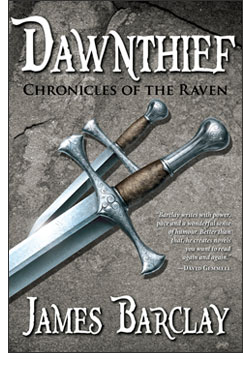
09-03-09: Pyr Imports 'Dawnthief' : Domestic Editions of Chronicles of the Raven
It's great to see what Lou Anders over at Pyr is doing, and all I can say is, it's about time! And it's not just as a service to readers, what he's doing. I've talked to Lou enough to know that when he publishes books because he thinks they're going to add to his bottom line. Take for example, Mark Chadbourn, with his Age of Misrule Trilogy. Readers surely remember me ranting about them back in the day. Anders has embraced them and is moving forward with more Chadbourn. US readers who haven't glommed on should pick up 'World's End', 'Darkest Hour' and 'Always Forever'. In movie review-speak, it's Lord of the Rings as written by Stephen King and set in the 21st century, as the science-driven society we inhabit winds down and a magic-based world erupts from within our cities. But there was another fantasy series I enjoyed as well — The Chronicles of the Raven by James Barclay.
It looks like I first mentioned 'Dawnthief' by James Barclay here back on 4/29/02, with the book review finally going up a few days later. I liked it then, and I like it now. It takes all the tropes of genre fantasy and pumps up the action, while preserving nuances of character. There's a genial sense of humor at work here, as well as a nice shot of darkness. Yes, you have the ragtag team — six men and an elf. But the violence has consequences, and wounds can be fatal. Magic works, but there's an economy behind that magic. It ain't free. There are four books in the series; 'Dawnthief', 'Noonshade' , 'Nightchild' and 'Elfsorrow'. The first two should really be read back-to-back; and the others in order, but they need not he quickly to hand. The originals came out as UK trade paperbacks from editor Simon Spanton over at Victor Gollancz. I expected them to be quickly picked up in the US; they're fun reading on all levels, and to my mind would naturally appeal to the US fantasy readers.
So count me in as fan, and let me suggest that US readers run, not walk, to pick up Podvcast'Dawnthief' (Pyr / Prometheus Books ; September 15, 2009 ; $16). Looks like Pyr is in for at least the first three — which is good — and my guess is, if they sell well enough, we'll see a lot more of Barclay's UK catalogue over here. To paraphrase Joe R. Lansdale, these aren't books of big thinks — they're epic fantasy with a gritty feel. Resorting to movie review-speak (again!), they're LOTR & Conan via Dirty Harry. Bad stuff happens to good people, who do NOT magically recover. Death is frequent and generally final.
Pyr's done a nice job here with the reading product. The binding is very excellent — you can open these up without worrying that the pages are going to fall out, which to be honest, was sort of an issue with the UK originals — printing technology has improved since, I'm guessing. The covers are classy and themed. The price is reasonable. You want some fantasy fiction to kick your ass the way that Conan did back in the day? This'll do the trick. And you can find it at your local independent bookseller — in the heathen lands of the West!
|
|
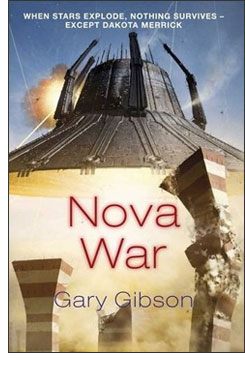
09-02-09: Gary Gibson's 'Nova War' : Trader in What?
Space opera is, by definition, written across a wide canvas. You're talking about humans spread out across the solar system, at least, the galaxy, in general, the universe, perhaps even the multi-verse. That means you have to have juggle a lot of perspectives, right? Keep things open, set up a huge cast of characters and rotate through the perspective of each one, that's the ticket. Unless you're Gary Gibson.
I enjoyed the hell out of 'Stealing Light,' and was suckered into believing it to be a standalone. So count me as feeling both foolish and lucky, now that 'Nova War' (Tor UK / Pan Macmillan ; September 4, 2009 ; £17.99) lands on my desk. Gibson's sequel to 'Stealing Light' entertainingly ups the ante but also keeps things on a bit lower level than readers of space opera may be used to. Of course, when you have lead characters like Dakota Merrick and Lucas Corso, it pays to keep things close. Especially if you've got an alien protagonist known as Trader in Faecal Matter of Animals.
Now I'm guessing that most of my readers have enough space opera savvy to have a general idea where 'Nova War' is headed. The Shoal have shown us the galaxy, but only so much. Their FTL drive is nice, but might be put to uses other than those we've seen. They might be engaged in activities that could result in the annihilation of humanity — as an afterthought. Dakota and Corso are working with Trader to prevent things from getting worse.
But then, in general, readers always have a pretty decent idea where space opera is going; getting there is the fun part, putting all the details in your mind for the big reveal you always know is to come. What Gibson does that's different is to approach big-scale space opera with a smaller scale perspective, letting his novel unfold like more of a violent thriller set in the future. He does put all the big thinks in, but they're on a more personal scale, in a more immediate manner. Gibson isn't re-inventing space opera or anything silly like that. I like his very alien aliens. As a writer, he's just doing what readers have been doing forever — taking it personally. It's literally a small difference, but it gives Gibson's novel a unique feel. And this time around he's quite clear — there're more to come.
|
|
09-01-09: Boom Times for Serious Fantasy : David Anthony Durham and Kate Elliott
This is a week full of good news for readers. There are a lot of books out there worth reading, big thick honkin' doorstop type-things that open up and simply say: "Lose Yourself." Kate Elliott and David Anthony Durham both offer series entries (and enders!) that are serious reading and ripping yarns. It's time to leave this damnable world behind — but only so you can get a better view.
Why not leave this world behind? If there's anything left of the handbasket, then that means we're only just a short hop away from hell. Otherwise if you're looking at a bunch of broken sticks and spinning wheels, well, just be glad that independent bookstores have a firm footing in this terra firma and some great new choices that need not feed the fire.
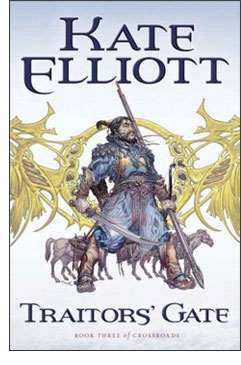
First to the finish is 'Traitor's Gate' (Tor / Forge / Tom Doherty Associates ; August 25, 2009 ; $27.99) by Kate Elliott, which concludes the Crossroads Trilogy that began with 'Spirit Gate' and was continued in 'Shadow Gate.' If you’re one of those people who like to wait until the final volume is out before starting the trilogy, your wait is over. Elliott's accomplished in three novels over three years what one might reasonably expect to take much longer. With 'Traitor's Gate' she concludes a wildly complex story with clarity and panache. If you like to immerse yourself in a fantasy world, Elliott's completed trilogy is a great place to do so. She hits every note just about perfectly. You get a great world and a great story.
Elliott's Crossroads Trilogy is an ultra-satisfying reading experience for any fantasy reader. On the prose level, she writes with grace and economy. She describes her world well, and creates characters within that world with whom we can easily empathize. She knows how to both describe a new world and keep the action moving in that world. And she writes with enough music in her words to make immersion easy and pleasurable. As a world builder, Elliott is clearly exceptional. Each society she creates is distinct and clear, and more importantly, a place that readers will enjoy visiting as a reading experience. She handles elements of the fantastic with a nice aplomb that keeps the sense of wonder intact while rendering the unreal in a realistic manner. And finally, she's a great plotter, deftly laying out a very complicated story over three books and bringing all the story arcs to a satisfying conclusion. Elliott's a very good example of why fantasy fiction continues to sell.
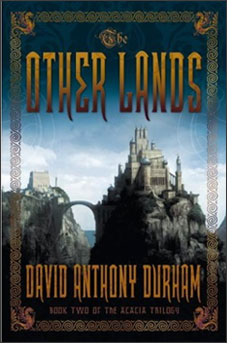
David Anthony Durham, meanwhile, turns in 'The Other Lands' (Doubleday / Random House ; September 15, 2009 ; $28), an excellent second installment in the Acacia Trilogy. Durham won a John C. Campbell award for the first novel in the series, 'Acacia,' and his follow-up is a solid, satisfying exploration of the fantasy genre with the eye of a historical novelist. Durham, like Elliott, creates a vivid, complicated world under siege, and explores it with exciting narration and entertainingly complicated characters. It is the second book of a trilogy, released on time, so those readers who prefer to await a conclusion of the trilogy might be able to budget their reading so that if they start 'Acacia' some six, seven months down the line, they can finish up the first two comfortably and be ready to pick up the conclusion when it arrives, hot off the shelves.
And it will be worth picking up. Durham has a singular voice in fantasy, and it is, as one might expect, well-informed by his historical writing. There's a sophistication and clarity here that will enable readers to fully immerse in Durham's psychologically and morally complex story of magic, monsters and conquest. To be honest, I was a little cautious about Durham's work, thinking, incorrectly, that he might not deal well or even at all with the elements of the fantastic that make fantasy fiction, er fantasy. But he's an outstanding creator or myths and the critters behind the myths, of magic and the power struggles that wrap themselves around any source of power. Most importantly, however, he gives us a gallery of characters who are all very distinct, very different, and yet to a one, enjoyable to read about. (Especially when they're dealing with monsters, but then, you know, I'm a kind of monster hound, so take what I say in that respect with a monstrous grain of salt.)
The weirdest aspect of either of these books is not within the books themselves, but instead, the actual publication of such books. These hardcovers are both nicely produced. Elliott's novels top out over 500 pages, but though the print is so small as to be potentially eye-ache-inducing that is not indeed the case. I don’t know what Tor is putting in their paper, but it works. Durham's novels are apparently a bit shorter, with larger type and a page count that climbs over 400. Still, that gives readers at least 2,300 pages (thus far; Durham's got one more to go) of fantasy worlds to explore. Great writing, complicated characters, moral and social woes that echo our own world in an imaginative fashion — this is what fantasy is all about. It's not about escape. It's about perspective.
|
|
08-31-09: Joey Comeau is 'Overqualified' : Dear Sir, With Bile
I hired more than a few employees in my tenure as an IT manager, then director. And I have to confess, I don’t believe I ever read a single cover letter. Or if I did, I don’t remember any. This is a clear indication that I never received a cover letter from Joey Comeau.
Dear Joey Comeau,
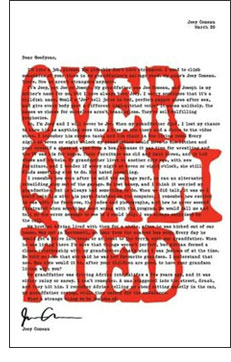
I was recently sent a cold-call email about your book 'Overqualified' (ECW Press ; April 2009 ; $14.95) by a publicity firm that shall remain unnamed. I'd like to suggest that in the future, you have your publisher contact me directly. Usually, missives from publicity firms are immediately deleted from my email spool. In a better world, sharks would feed on the remoras that cling to them.
That said, the very idea of a collection of cover letters appealed to me, and against my usual inclination, I asked the publicist to send me a copy of your book, which arrived pretty quickly. I tore open the envelope and set 'Overqualified' atop the pile of books on the living room table.
It didn't take long for me to open it and read one of the cover letters, and after that, the reading went pretty fast. In fact, I read the book more quickly than I wanted, because it was so easy to read. Let me suggest that this book is would make an outstanding addition to any bathroom or bed stand. It invites the sort of fragmented reading one accomplishes in these locations, though frankly the tone is more appropriate for the former than the latter.
Obviously, you're not the first guy to invent the funny cover letter. Back in the before-time, when the World Wide Web wasn't even a thesis paper, I read a very funny cover letter via the Usenet News Groups, wherein the author made all sort of claims of having saved the world, rescued kittens, you know — a sort of sweet braggadocio that was transparently fake but ultimately charming, and so legend has it, got the guy his job.
Your letters aren't like that.
Oh, you've got the form down, make no mistake about it. Many of these start out like something approximating a real cover letter. (And many don't.) But soon, you take a surreal, obnoxious, or simply weird turn. Let's start with the first, just to give folks a feel for what’s to come:
"Dear Irving Oil,
I am writing to apply for a job with your company, and I have included my resume for your review. You will find every reference and each previous job check out as valid, but I think that it's important to be honest: my assigned mission is to take you down, from the inside."
What follows is effectively a science fiction story, juiced up, like pretty much everything in this book, with a strong sense of bilious humor that really just burns. And it is only the first of some number I can't be bothered to count. You tell a lot of stories in this book, all them strange and emotionally honest, even when the content is outrageously fabricated. You tell General Electric that their line of water heaters is flawed, then go on to talk about skinny dipping and Jason Vorhees. You tell Goodyear about your family (probably a farrago of lies, but it feels true — good job!) and Bell Canada, "There could be eggs anywhere in your body. I have to tear out its backbone." There's both a lot of variety here in terms of subject, but a unifying tone of single-minded disgust, a fiery hatred of what I would call, "The Man." Note from the beginning of this article that I used to be The Man.
You are clearly the most ruthless faux job applicant ever to cadge together a collection of prose. Yes, these letters are funny — sort of. But they're also caustic, slightly terrorizing and more than a little bit frightening. I can't honestly say that I totally enjoy the way you relentlessly cross the line, again and again, but I certainly respect it. There's a bracing consistency here. And yes, they tell us a lot about living in the 20th and 21st century, assuming one lives in a semi-urban surreal hell of endless tension.
The book itself, as a book, excepting the words, is quite nice. ECW has given you a great platform from which to rant. Binding printing and art direction all served the ultimate purpose of getting me to read. I'm wondering if you've considered a sort of performance art tour, moving from city to city, wandering around the downtown with a "HIRE ME" sign around your neck, reading the letters aloud, or just taking a five-gallon paint bucket, upending it and standing atop it to spread your message. You have a website, of course, incongruously called "A Softer World". But your perspective in this book suggests that you sleep on a bed of nails.
In closing, I'd like to suggest that you punt the publicists and go straight to Indie-Bound or one of the other Independent Bookstore promoters to get the word out about this book. If I picked it up in a bookstore, I'd probably buy it, bring it home and put it in my bathroom. Or, if I were still employed, I'd bring it to work and give it to the HR Department. I bet they'd enjoy getting letters like yours, though the severity of your tone might give them pause. I'm hoping that you never land a real job.
Sincerely,
Rick Kleffel
Bookotron: The Agony Column
Bookotron.com/agony/index.html
|
|
|
|
|
|
|