03-26-10: Jack Bowen Peels Off 'If You Can Read This: The Philosophy of Bumper Stickers'
A Brief History of Thought
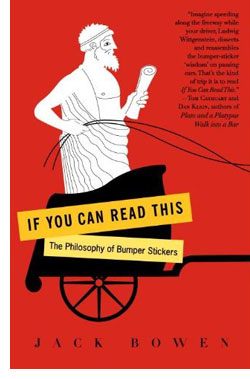
It doesn't take much to get you started. The average, at least according to Jack Bowen, author of 'If You Can Read This: The Philosophy of Bumper Stickers' (Random House ; March 23, 2010 ; $14) is 8.1 words.
That's the average number of words on any given bumper sticker, at least in Bowen's experience, and he has had plenty. Bowen, with his wife's help, collected over 2,000 bumper stickers, then started to break down the philosophy they imply. Since he teaches the Stanford Summer Philosophy Camp, he's got the qualifications. And if you can read 'If You Can Read This,' you'll find that Jack Bowen manages to fight the Battle of the Bumper Sticker and bring in a home run — for philosophy.
Bowen's idea here is to give readers a Brief History of Thought using bumper sticker wisdom, such as it is, as a springboard for examining what we put on our bumpers and what it says about us, and even more, what it says. You might think that's obvious, but you'd be wrong, and here's where the fun begins.
As Bowen sorts out the bumper stickers according to well-conceived categories, he takes a trip through the history of philosophy. From musings on reality ("Don't Label Me"), he gets into Plato and that damnable Cave of Shadows. Or he stops by and thinks about psychics ("Why do psychics have to ask your name?"). Bowen has a great talent for starting with a good joke and leading readers down the primrose path of actual argument and philosophic inquiry — painlessly. Entertainingly, even.
Bowen's book is both interesting and entertaining on a number of levels. As you read 'If You Can Read This,' you'll realize that there are not only genres of bumper stickers, there are genres of philosophy. Some deal with the personal questions of the self ("I heart" ... whatever!), and Bowen brings back a personal favorite of mine, Christopher Lasch's 'The Culture of Narcissism,' a book I feel to be eternally relevant to our culture, especially now. Others deal with larger questions of God and Religion, and sure as shootin', you're going to get your self a nice dose of Nietzsche, served neat.
Bowen's talent is for finding the contradictions inherent in what seem like pithy, coherent little aphorisms, then teasing out the actual philosophers who have considered these issues and bringing back their thoughts in an entertaining manner. He'll get the Bioethics Commission, biology itself and multiple versions of Michael Jordan marching across two brief pages after considering "Clones are people too." He draws from a diversity of sources to keep the reading entertaining and the philosophy easily ingested into whatever shattered remains there are of our tiny brains.
'If You Can Read This' might be considered a sort of gateway drug book, in that it might, hopefully, lead readers to consider looking at the texts which Bowen clearly understands to the point of being able to summarize them effectively. Or it might just lead to an interesting conversation with either your riders or yourself, the next time you drive. We see bumper stickers and think "Clever!" or "Annoying!" After reading this book, you'll think about not just the words on the bumper, but the thoughts behind those words, and even consider the driver behind the wheel of that car as an individual. There's a good argument to be made that a book like this can actually change your world view. If, of course, you're up on your philosophers
03-25-10: Michael Pollan Lays Down the Law
'Food Rules' — The Pocket Palate
It's easy to be cynical. There are a lot of books out there, and Theodore Sturgeon is right. Most of them are crud.
But then again, after tossing back the crud, there are still a lot of books out there. Even with the odds stacked against you, you can go right.
But cynicism is a tough foe. So when you see a good guy who seems to be cashing in on his good notice, you think, well, cut him a break. He deserves a softball now and then.
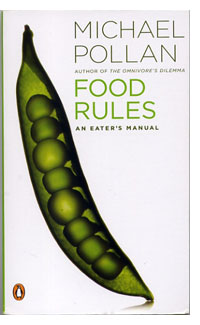
That was my first thought when I saw 'Food Rules: An Eater's Manual' (Penguin / Putnam ; December 9, 2009 ; $11) by Michael Pollan. But eventually, I picked it up and actually read it. More importantly, I put it to use, and that is where it proved its mettle. 'Food Rules' is not a book meant to be left at home. It is the proverbial pocket (or purse) book. Do not treat it gently. Take it with you to the grocery store, bend it to hell and back, but Pay Attention — or just pay.
Michael Pollan casts a pretty big shadow across our eating landscape these days. His books 'The Omnivore's Dilemma' and 'In Defense of Food' were huge bestsellers. 'The Botany of Desire' was adapted into a PBS series. Pollan appeared in Food, Inc., a recent documentary on the food industry. It's easy to think that 'Food Rules' is just the latest product from Michel Pollan, Inc.
But if you first read 'The Omnivore's Dilemma' and then 'In Defense of Food,' it's clear that 'Food Rules' was in the offing. Pollan has been sharpening his focus with each book, getting closer and closer to prescription he offers here. With the help of other food activists and food writers — a diverse group, like cookbook author Mollie Katzen and historian Ann Villeisis — Pollan is fighting a battle for the American appetite, trying to make sure it is directed in a manner that will entertain our palate without busting our bellies or our bankbooks. 'Food Rules' is the literary handgun in this epic fight.
I'm sitting in a house the is fragrant with the smell of just-baked honey-wheat bread from 'Artisan Bread in Five Minutes a Day.' I know exactly what is in that bread. Whole wheat flour. Water. Milk. Yeast. Honey. 100% expellor-pressed canola oil. Knowing what you're eating is half the battle, though I must hasten to add that having hot, fresh bread daily is a temptation that has some dietary downsides. That said, the press for fresh, home-made food is as economical as it is enjoyable. 'Food Rules' is a book that you can bring with you to the store, or just sit down and read bits of daily. The reminders will help keep you focused in much the same manner as Pollan has sharpened his focus.
'Food Rules' is pretty simple. It is a series of 64 rules, divided into three parts; "What should I eat? (Eat food.)," "What kind of food should I eat? (Mostly plants.)," and "How should I eat? (Not too much.)." [When you have that fresh honey wheat bread around, the last one is a toughie.] Each rule is a single, smart sentence, printed in really big type; sometimes it's quite self explanatory, for example, "Don't ingest food made in places where everyone is required to wear a surgical cap." Pollan's mordant sense of humor helps this batch of medicine go down; 'Food Rules' is a pretty damn funny, in the vein of, "That's not funny, it's true!" Yes, it is funny; yes, it is true.
Some of these rules get a page or more of explication; "Eat your colors," for example, follows grandma's proverb up with current medical science. And some are being borne out by discoveries in other arenas. "Eat less," for example, we see reflected in our inclination to eat more. A recent study by Cornell University examined depictions of The Last Supper and found that the amount of food on those plates has increased over the years — and that's just looking at paintings between 1000 AD and 1700 AD. http://news.bbc.co.uk/2/hi/health/8580146.stm One can imagine the fast food version of The Last Supper, and it's not a pretty picture.
Yes, this book is pricey. Eleven bucks for a mass-market paperback is a new record, and this isn't even one of those weird long paperbacks that they're trying to foist off on us. On the other hand, take this book to the store with you just three times then consult it while you're shopping and you'll not only save at least eleven greenbacks, you're very likely to extend your life, at least by the amount of time you spend shopping. As far as the cost of 'Food Rules' goes, I will say that it is very nicely laid out and designed by Sabrina Bowers. The nicely-done clip art makes the whole thing seem like a quality production. There are not so many ingredients in 'Food Rules.' Smart writing. Great focus. The sort of advice you can actually take to the store, and then home, with luck to the smell of fresh-baked honey wheat bread.
03-24-10:Dexter Palmer Recalls 'The Dream of Perpetual Motion'
Steampunk Tropes, Literary Fiction
It's tempting to think of "steampunk" as a fashion statement, or a very specialized genre of literature. There are good reasons for that temptation. Every time we turn around, it seems someone has gone and designed some piece of leather-based clothing with so many elaborate details as to render it useless for anything but display at a fan convention — and there are plenty of those to go around.
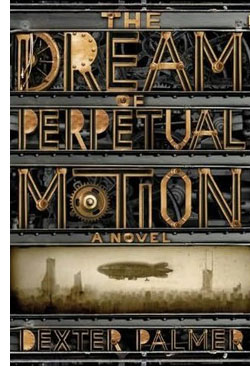
As for the fiction, it's no doubt a lot of fun. Works like 'The Affinity Bridge' by George Mann, Cherie's Priest's 'Boneshaker,' and seemingly a dozen more each week offer wild, over-the-top adventures, larger-than-life characters, and at least one zeppelin per novel. Zombies are not de rigeur, but certainly appreciated. The feel of these books is that of the dime-store novels of yore that may or may not have actually existed or been any good. An alternate history is extra-helpful. The cover art must feature that zeppelin, whether it's in the book or not. These are clearly books — and fashion — for science fiction readers. Steampunk is a specialized subset of that genre, an end that one achieves by filling in some blanks and including that airship.
But any style or subset can be cannibalized and used not as end in itself, but a means to an end. Dexter Palmer does just this, using the steampunk tropes, including that damn airship, the mechanical men, the alternate history in service of a literary novel. Palmer's first novel, 'The Dream of Perpetual Motion' (St. Martin's Press ; March 2, 2010 ; $24.99) uses all the steampunk tropes, but is not a straightforward adventure. Instead, it's a literary meditation on the power of language, communication of any sort with other humans, what exactly it means to be human in an age of machines, no matter how primitive (or advanced) they might seem by our standards, just what is primitive and advanced, and how we patch together our life stream — all this via Shakespeare's The Tempest.
And a zeppelin.
I'm pretty sure that the literature of the year 2013 will require, by rule of law, that every book published have a zeppelin on the cover. For ebooks of any type, plan on animating that zeppelin in a sort of stop-motion and sepia tone that makes it look like it came straight from a 1930's newsreel.
So yes, the hoary clichés of steampunk may soon overwhelm our sensibilities, but in the interim, we've got some very nice reading on our hands. Palmer's novel is the story of Harold Winslow, who lives in the sort of world that those who haunt the steampunk conventions would sell their souls to slip into. He's imprisoned on a zeppelin owned by Prospero Taligent, whose steampunk vision runs the world. As much as a frozen corpse can own a zeppelin. It's complicated. And therein lies the charm and challenge of 'The Dream of Perpetual Motion.'
If you're looking for an adventure full of daring-do and blunderbusses, maybe you want to read another book. Just look for the next one with a — well, you know. The Dream of Perpetual Motion' is just that, and includes a fair number of surreal dreams, as well as diary entries, notes, asides, and meditations on silence. As flies to wanton boys are Harold's stories to the literary gods who peel them apart and then layer them in a fascinating mosaic of not-irrational narrative shifts. "...it's endless unsatisfied desire that makes us human," Prospero Taligent tells an assembly of children. And yes, Virginia, there is a Caliban.
And so far as satisfied wishes go, 'The Dream of Perpetual Motion' will certainly quench your thirst for a literary steampunk excursion, and perhaps whet your appetite for more — fiction by Palmer and, perhaps, a quick trip through the stacks. Palmer's dissertation drew on the work of James Joyce, William Gaddis and Thomas Pynchon. If you're looking for roots, these are good places to start digging. You will have to leave the zeppelin, though.
03-23-10:Ann and Jeff VanderMeer Cook Up 'The Kosher Guide to Imaginary Animals'
Set Your Inner Evil Monkey Free
Trying to keep up with the VanderMeers? Good luck with that! Ann and Jeff have had themselves cloned, multiple times, and sent the clones into dimensions closely adjacent to ours to work in conditions that ... Well, you know (or should know) how ick-iferous Jeff's imagination can get. So try not to imagine what keeps the clones going.
Instead, enjoy their output in this dimension, or should I say — in today's science-fiction idiom — this quantum iteration. Poof! Before your very eyes, the fine folks over at Tachyon will materialize for your amusement, amazement and culinary benefit, 'The Kosher Guide to Imaginary Animals: The Evil Monkey Dialogues' (Tachyon Publications ; March 2010 ; $11.95). All the joy of a John Coulthart-designed limited-edition deluxe-o-matic super-costly, we-printed-five-of-them-and-stapled-them-to-our-grandchildren edition at the bargain price of twelve bucks? Beyond a Baked Dragon Burrito, (sorry, can't have it, Dragons aren't kosher!), what's not to like?
Some books just seem so duh, in that, of course you must own that book. And 'The Kosher Guide to Imaginary Animals: The Evil Monkey Dialogues' could be in it's own sort of dictionary, illustrating Very Easy Books to Buy. It's fun, it's funny, it has a monster on just about every other page, so I suppose I should just stop here and let you get one with buying it.
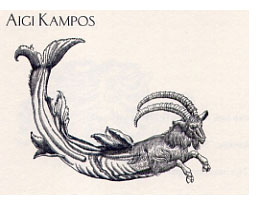
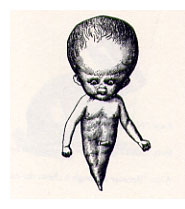
So the idea here is a sort of bestiary — a form of book I adore, and always have — with the intent to not just describe the various beasts, but to determine if they are kosher. You know, if you can bless 'em, kill 'em and cook 'em in roughly that order without peril to your immortal soul.
Here's the menu for this lovely little book, Lilliput's #1 bestseller. First, have one of your clones dragoon John Coulthart. Give him a list of some imaginary animals, familiar and weird (and I'm talking weird on a VanderMeer scale), and command unto him:
"John Coulthart, illustrate these beasts lest we smite your limbs with black, stinking buboes!"
Then, find a free pair of VanderMeers amidst your quantum iterations. The two of them will likely collaborate in an unclear manner on the critter descriptions. Then, Ann will attempt to engage Jeff in a dialogue. But, you know (or should know by now) Jeff. It is perilous to attract his attention.
In this case what apparently happened, in a repeatable but unpredictable manner, is that Jeff refused to answer his wife, but the Evil Monkey within did, with results that were clearly frustrating for Ann but are enjoyable for the reader. Repeat until you've got yourself a decent bestiary. But wait — there's more!
Duff Goldman, who is apparently the star of a television program called Ace of Cakes, also takes questions, from Ann, giving his (presumably professional) opinion on the preparation of these mythical feasts. That's the kosher-critter guide chaser.
I will say that I was hoping for some recipes, I mean — if you say that you can cook, say a Jotai or Behemoth, the very next natural question is, how? I probably won't have to wait long to find out — that wasn't too long, was it? Here they are, recipe cards in PDF files. In some quantum iteration, I'm sure there are a couple of VanderMeers with the patented SquidCom Remote working on the sequel. Hmmm. I wonder if the SquidCom is kosher? And if you can cook it without it getting tough?
03-22-10:Steven Erikson Breathes 'Dust of Dreams'
Penultimate Malazan?
When does ten years seem like a short time to write a fantasy series? When the author manages to nine books in ten years — of what we were told, originally, would be a ten book series. And here is here things get tricky.
I remember back in the day when 'Gardens of the Moon' first came out, alas, as a mass-market paperback, from, I believe, Canada. I loved the way it was written, dense as hard stone, intense and surreal and supernatural in a manner that made the supernatural seem natural. Only one little problem with this thick-as-a-brick book. It was the first in a ten book series. How long would we have to wait to find out what happens in the story arc that Erikson began?
The answer to this question may just depend on what you, or rather Steven Erikson, means by "book."
If by "book" he means a single story (even as contained within the arc of a long series), then we may not be as close as we hope. But, if by book, he means "thing between covers with pages in between," then we're a tantalizing breath (comparatively speaking) away.
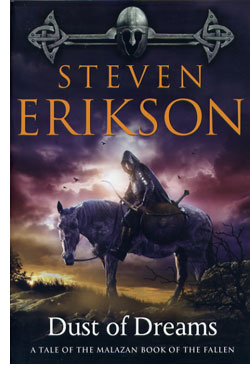
All of this goes to the aid of your decision as to whether or not you want to start 'Dust of Dreams' (Tor / Tom Doherty Associates ; January 19, 2010 ; $17.99) right now or ... hold off a bit. When you're talking about completing a series that you've been reading for ten years then this question assumes a lot of importance. Add up the hours you've spent in Malazan.
They're about to come to an end.
Or at least the initial series is; we have promises of other works, but not of this depth. So the idea is, you've spent a significant amount of time and money on your Malazan vacation. You want to maximize your reading pleasure, your reading intensity, as you head towards the finish line. You also want to make sure that line doesn't move out, in a manner that fantasy readers are all-too-accustomed to experiencing.
And that's where 'Dust of Dreams' comes in. Erikson has thus far in this admirable series been quite good at ending each novel in a manner befitting a novel as much as an additional installment in a much longer story. Each book in the ten book series has been a whole book, no Eric the half-a-books.
Until now. Erikson is kind and smart enough to warn his readers going in, so it's not like I'm going to be giving away any spoilers. He indicates he has both a sense of humor and an alternative perspective with regards to the size of books, telling us he is, "not known for writing door-stopping tomes." Now, this particular installment is 816 pages of teeny-tiny type. Even in the trade paperback version, I'm thinking this could definitely stop a door.
Maybe not in Malazan, though, where the doors are the sort of stone monoliths that could easily take those wimpy 2001 monolith-wannabes. But what Erikson is getting at is that 'Dust of Dreams' is indeed an Eric the half-a-book. It comes to a screeching halt in the middle of everything, so, if you want to buy it, and you'd be well-advised to, then you might wan t to hold back on reading it until the second half of the book ('The Crippled God') comes out, er, in a while. Now here's where what Erikson means by "book" starts to assume some importance.
We know that publishers are not enamored of big-ass books. Thus the small print in 'Dust of Dreams,' and the innumerable books that have been published as one tome in the UK only to show up here as two, and sometimes even four volumes, books — whatever!
If by "book" in the Reader's Note, Erikson means that 'Dust of Dreams' and 'The Crippled God' comprise one more volume in the series, then the two of them together might justifiably be seen as book nine in the ten book series. And, then, there could be yet another "book" to complete the projected "Ten book series," which itself might consist of what two? Three? Four books? Can a fantasy series attain a "Xeno's paradox" state, where each successive volume gets you halfway closer to the end — but never there?
I really don't think that's the case here. I think that Erikson is an honorable author, and that the demands of the series arc just required that he end the book where he did, and that ... is that. Sometime in the next mumble-mumble we'll get the final book in the series, 'The Crippled God,' and then ... wait for it — Erikson can begin work on a prequel series, because he really did start 'Gardens of the Moon' in media res. Make no mistake about it. The Malazan Book of the Fallen is a grand achievement, truly adult storytelling, not just in gory action content, but also in terms of scope and emotion. All it really needs is two words.
New to the Agony Column
09-18-15: Commentary : William T. Vollman Amidst 'The Dying Grass' : An Epic Exploration of Simultaneity
Agony Column Podcast News Report : A 2015 Interview with William T. Vollman : "...a lot of long words that in our language are sentences..."
09-05-15: Commentary : Susan Casey Listens to 'Voices in the Ocean' : Science, Empathy and Self
Agony Column Podcast News Report : A 2015 Interview with Susan Casey : "...the reporting for this book was emotionally difficult at times..."
08-21-15: Agony Column Podcast News Report : Senator Claire McCaskill is 'Plenty Ladylike' : Internalizing Determination to Overcome Sexism [Incudes Time to Read EP 211: Claire McCaskill, Plenty Ladylike, plus A 2015 Interview with Senator Claire McCaskill]
Agony Column Podcast News Report : Emily Schultz Unleashes 'The Blondes' : A Cure by Color [Incudes Time to Read EP 210: Emily Schultz, The Blondes, plus A 2015 Interview with Emily Schultz]
07-05-15: Commentary : Dr. Michael Gazzaniga Tells Tales from Both Sides of the Brain : A Life in Neuroscience Reveals the Life of Science
Agony Column Podcast News Report : A 2015 Interview with Michael Gazzaniga : "We made the first observation and BAM there was the disconnection effect..."
04-21-15: Commentary : Kazuo Ishiguro Unearths 'The Buried Giant' : The Mist of Myth and Memory
Agony Column Podcast News Report : A 2015 Interview with Kazuo Ishiguro : ".... by the time I was writing this novel, the lines between what was fantasy and what was real had blurred for me..."
Agony Column Podcast News Report : A 2015 Interview with Marc Goodman : "...every physical object around us is being transformed, one way or another, into an information technology..."
Agony Column Podcast News Report UPDATE: Time to Read Episode 199: Marc Goodman : Future Crimes: Everything Is Connected, Everyone Is Vulnerable and What We Can Do About It