06-17-10:Georges-Olivier Châteaureynaud Lives 'A Life on Paper'
Translating the Ineffable
Writing is itself a translation. To set down words that have as a referent, some series of events in or portions of that which we experience, is an act of translating perceptions and imaginations into language.
Often what one might wish to write about are things which do not yield easily to finger-pointing or photography. The emotion of love, the feeling that you are being watched; all of these require translation into language. Once you've done that, the rest is easy.
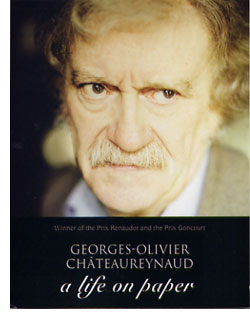
Georges-Olivier Châteaureynaud is big deal in France. He's compared favorably to top-shelf American writers. If you can read French, you can look him up on Wikipedia, but he's been otherwise mostly invisible in the States until now. With the publication of 'A Life on Paper' (Small Beer Press ; May 25, 2010 $22), the English-reading world can get a chance to wrap their brains around twenty-two short stories. Brain-wrapping is an appropriate description of the reading experience with regards to Châteaureynaud. His surreal, slippery style offers readers one absurdity after another rendered with a relentlessly precise style. It's a happy union of opposites that makes head-scratching incomprehension a joie de vivre.
Châteaureynaud's stories are generally short and resist easy descriptions, but I can try to give readers a flavor of what is in here. In "The Pest," the narrator is driven to the brink of suicide by an unfortunate acquaintance. "But if I got there only to find him, that groper, that toady, in all his sniveling bonhomie, ready to stick by me for the rest of eternity, well, it wasn't worth it." "Icarus Saved from the Skies" finds a young man in the midst of an unnatural transformation. "In the course of a few days, I sprouted wings, rather, wingbuds. At first naked, pinkish, coarse, and altogether repugnant, these excrescences were soon covered in a chick's yellow down. Thank God for small favors. When I craned my neck to see my back in the bathroom mirror, the down honestly made those extra extremities easier on the eye."
Remarkably enough, it's the prose, translated by Edward Gauvin, that shines here. The straightforward thrust, the matter-of-fact descriptions give Châteaureynaud's work a power that cuts through his weird and fantastic situations. In fact, the weird and fantastic situations are often weird and fantastic in a very prosaic manner. Châteaureynaud eschews epiphanies and neat endings in favor of abrupt cuts and full-stops. But the effect, very deliberate, is to translate the fantastic into prose of any language. Châteaureynaud's achieves that with an envious ease. He knows just how unmoored we are from reality.
'A Life on Paper' is a brief selection from more than thirty years of fiction. Châteaureynaud has a backlist for American readers that this book makes enticingly tangible, almost real. His own work is such that it might be subject of one of his stories. This might be all there is, the rest pure fabrication. The unreal, awaiting translation.
06-17-10: Fantasy in the City
Mark Chadbourn and Mark Charan Newton Subvert Reality and Genre
Fantasy is the biggest umbrella. I suppose you could blame Heisenberg as much as Tolkein. But one can fairly say that all fiction is a subgenre of fantasy. True, but it doesn't help you find a good book! For that, you have to go to your independent bookseller.
Here in the US of A, we've finally got some prime examples of fantasy fiction trickling in from across Atlantic. Mark Chadbourn's Age of Misrule trilogy ('World's End,' 'Darkest Hour' and 'Always Forever') was something of a game change for the genre. Chadbourne set a fantasy quest epic in a 21st Century Britain where the laws of science were winding down as the rule of magic was gearing up. Mark Charan channeled Charles Dickens so that he could spend 'Nights in Villamajur.' Both subvert the clichés of fantasy, and both have new work easily buyable in the US.
Mark Charan Newton's 'Nights in Villjamur (Spectra / Bantam / Random House ; June 29, 2010 ; $26) is a complicated, dense and involving novel that I first wrote about here. Now available in the US, Charan's debut is chock full of weird creatures and involving characters — sometimes both at once. Villjamur is a city that is overflowing with refugees from an impending ice-age and fraught with inter-species strife. Murder is appallingly common and about to grow more so.
Newton is smart enough to simply show us a life we can barely comprehend, at least at first. He intertwines a murder mystery with two others — just what is going to happen with regards to the city of Villjamur itself and moreover, just what in fact is the city of Villjamur. We explore the world and investigate the mystery in the same sentences. Newton creates a detailed secondary-world fantasy, and then unfolds complex plots that we might find in our world. the combination of familiar and unfamiliar creates great tension and ensure that every night readers spend in Villjamur is fresh and exciting.
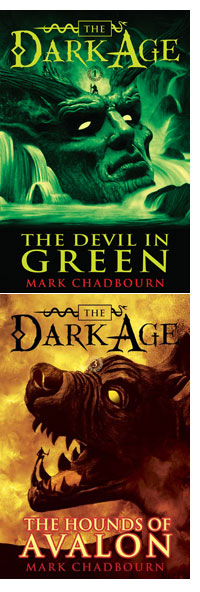
Mark Chadbourne works in the opposite direction. In his Age of Misrule trilogy, he began the process of converting a familiar 21st century Britain to world populated by the fantastic. Now Pyr is in the process of releasing the next trilogy set in a post-conversion world where the fantastic rules. The first novel in the sequence was 'The Devil in Green' (Pyr / Prometheus ; May 25, 2010 ; $16) ; the next novel in sequence, 'The Queen of Sinister' (Pyr / Prometheus ; June 3, 2010 ; $16) has just been released; and the third and final book, 'The Hounds of Avalon' (Pyr / Prometheus ; July 27, 2010 ; $16) will be in stores shortly. John Picacio is still doing the outstanding cover art, and Chadbourn's follow through is every bit as exciting and surreal as the first set.
In The Dark Age trilogy, Chadbourn takes the opportunity to use his fantastic overlay to externalize all manner of discussions, from the influence and use of military power to the influence and use of fundamentalist religions. But he never loses sight of story and character, giving us analogues to Rose and Church fro the first trilogy, the protagonists of the first trilogy and hinting at their return.
Charbourn is quite fast-paced, and his novels read like thrillers with an imaginative leap that most thrillers never manage to make. It would take just a Moebius half-twist of luck and publicity to turn these books into best-sellers, but they're better than that. Still, they have a very wide range of appeal.
Both Chadbourn and Newton are perfect exemplars of a new form of fantasy that offers all the pleasures of the imagination with the sort of deep in-this-world hooks that ground the work and enable readers to identify with those trapped in situations far stranger than ours. Or, as you immerse yourself in the stories, situations that reveal just how strange our world has become.
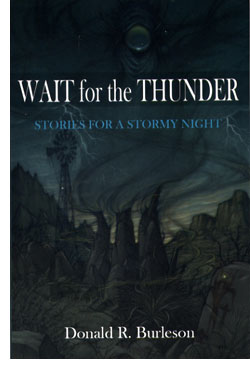
06-15-10:Donald R. Burleson Whispers 'Wait for the Thunder'
Stories for a Stormy Night
He lives in Roswell.
That's not all you need to know, but it's a good start. Donald R. Burleson is a name that has been in the background of my life for more years than I can remember. Have a very faint but definite memory of an old hardcover I saw at Aladdin Books in Fullerton — it was purplish and blue? Perhaps I am mistaken. Or perhaps the universe has gobbled it up. It's the sort of thing that happens in his stories.
Readers looking for a classy, classic collection of horror stories need look no further than 'Wait for the Thunder: Stories for a Stormy Night' (Hippocampus Press ; June 1, 2010 ; $20) by Donald L. Burleson. Hippocampus is rapidly becoming the king of nicely produced horror fiction short story collections in trade paperback. I suppose it is a peculiar niche, but here's evidence that it is an important one. By putting together a collection of varied horror stories from Burleson, Hippocampus once again demonstrates that the strength of horror fiction is twofold; it can work across a variety of moods and situations, and it is the best vehicle for externalizing that which we'd really rather not recognize.
Burleson's forte is the one-sitting story; here you'll find 26 stories and one novella in a 300-page book. The stories run the gamut of style and subject. You get a monster under the bed in "Fwoo," or a slice of life and death from his current digs in New Mexico in "Sheep-Eye." If "The Watcher at the Window" has a title reminiscent of Lovecraft, that's no mistake, but Burleson evokes the spirit of Lovecraft without getting caught up in the unpronounceable names. The title story offers a dark spin on the famous Bertrand Russell anecdote about "Turtles all the way down." And the novella, "Papa Loaty," from the Gary Fry / Gray Friar Press collection 'Poe's Progeny' rounds back to the folklore of New Mexico.
Burleson is careful not over-stylize or over-write his stories. The subtitle of this collection, "Stories for a Storm Night" is actually pretty important. These are the kinds of stories that you used to tell your friends, or read alone, hiding under the covers at night. They're simple, strong, and have a knack for remaining in your memory, stubbornly, waiting to ambush you somewhere down the line.
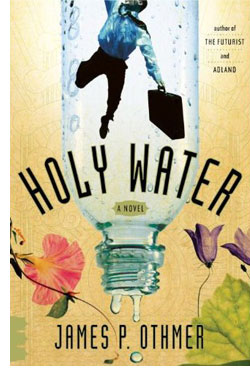
06-14-10:James P. Othmer Drinks the 'Holy Water'
Backing Into the Future
Talking to James P. Othmer can get a fellow into trouble. And reading James P. Othmer may make trouble seem like the last of your problems.
Perhaps I should explain.
I spoke to Othmer back when I was living a rather different life. The world was living a rather different life. Othmer had been a High God of Advertising who decided to write a novel, 'The Futurist,' about an advertising executive who makes a career-ending speech to declare himself the leader of the "Coalition of the Clueless." 'The Futurist' is one of those novels that blurs the line between satire and reality, or rather makes the reader realize just how arbitrary such distinctions are.
When I spoke with Othmer back in 2006, we had a grand conversation about both his novels and his years in the world of advertising. At the time, I was not ... um ... shall we say, empowered, to host my own show on NPR affiliate KUSP. So each week, I'd turn in a CD to a now-departed-from-the-station producer who would play it. I edited the interview to ensure it was the correct length, turned it in, and the show was aired. That was when what I can literally call a shitstorm began.
You see, in talking with Othmer, I just had one of those connections that interviewers sometimes get with those to whom they speak. So when Othmer talked about the bullshitting involved in his career in advertising, well it seemed like natural language to me. Not to my producer, however, who seemed to take great delight in sending me a warning letter that threatened a $30K fine that would then (and more so now) have bankrupted me.
As it happens, both Othmer and I survived. He followed up 'The Futurist' with 'Adland,' a memoir about the time he spent, well, doing something for more money than God I'd be inclined to describe with a word I still cannot broadcast. Having one-upped God on the pay scale, Othmer is not content to let things alone, so now he has a second novel titled 'Holy Water' (Doubleday / Radom House ; June 15, 2010 ; $26.95), in which one Henry Tuhoe, a middle manager for an anonymizing multinational corporation, is offered the 21st century version of a severed horse's head on his therapeutic pillow. Like most of us, Henry lives in a world where news by definition is generally not good.
Henry's well-heeled corporate life is neither so well nor heeled as he or readers might expect. Things go awry, badly so. The problem is, that when you're already living in a dystopia, it's hard to tell bad from worse, let alone find any good in one's general vicinity. Even when that has been radically shifted to a kingdom with a fairy tale name and a thoroughly-hacked email server. Is Henry in a world of something I cannot broadcast on the radio? Or are all of us in such a world, with Henry's perceptions and plights merely a way to bring this truth humorously, if hurtfully home?
Othmer's a canny guy. He spent years bullshitting with the experts and came away with away with mad skills at same, the kind of skills that make him a writer who is simultaneously immensely entertaining and uncomfortably unnerving. Suffice it to say, give up on the Fiji Water before you begin this book. In fact, you'd be well advised to declare your own personal Lent. You will be allowed to laugh however.
One of the reasons I like Othmer's work is that he resides in a peculiar gray area with regards to genre. It's almost as if the writer were backing into the future. Sure, 'Holy Water' is satire, set in the present day. But there's a science-fictional feel to this novel, a sort of surreal vision of the present as if it were in fact an unsustainable future we might hope to avoid.
As if.
I think that the vision of our world as something we might avoid is far more persistent and relevant than one might presume. In fact, it is easy to pretend that the present is indeed some sort of future that may not come to pass. This conflation of present and future is a particularly modern mental ailment. It's easy to ignore the facts around us, the ecocide, the genocide, the concentration of wealth and power in an elite, multinational class that seems happy to wreck the planet so long as their party is not brought to an end. We're all so busy trying to keep up our websites that we can pretend it's not all going to shit.
Just drink the water.
New to the Agony Column
09-18-15: Commentary : William T. Vollman Amidst 'The Dying Grass' : An Epic Exploration of Simultaneity
Agony Column Podcast News Report : A 2015 Interview with William T. Vollman : "...a lot of long words that in our language are sentences..."
09-05-15: Commentary : Susan Casey Listens to 'Voices in the Ocean' : Science, Empathy and Self
Agony Column Podcast News Report : A 2015 Interview with Susan Casey : "...the reporting for this book was emotionally difficult at times..."
08-21-15: Agony Column Podcast News Report : Senator Claire McCaskill is 'Plenty Ladylike' : Internalizing Determination to Overcome Sexism [Incudes Time to Read EP 211: Claire McCaskill, Plenty Ladylike, plus A 2015 Interview with Senator Claire McCaskill]
Agony Column Podcast News Report : Emily Schultz Unleashes 'The Blondes' : A Cure by Color [Incudes Time to Read EP 210: Emily Schultz, The Blondes, plus A 2015 Interview with Emily Schultz]
07-05-15: Commentary : Dr. Michael Gazzaniga Tells Tales from Both Sides of the Brain : A Life in Neuroscience Reveals the Life of Science
Agony Column Podcast News Report : A 2015 Interview with Michael Gazzaniga : "We made the first observation and BAM there was the disconnection effect..."
04-21-15: Commentary : Kazuo Ishiguro Unearths 'The Buried Giant' : The Mist of Myth and Memory
Agony Column Podcast News Report : A 2015 Interview with Kazuo Ishiguro : ".... by the time I was writing this novel, the lines between what was fantasy and what was real had blurred for me..."
Agony Column Podcast News Report : A 2015 Interview with Marc Goodman : "...every physical object around us is being transformed, one way or another, into an information technology..."
Agony Column Podcast News Report UPDATE: Time to Read Episode 199: Marc Goodman : Future Crimes: Everything Is Connected, Everyone Is Vulnerable and What We Can Do About It