"In Chinese, the language itself is visual poetry."
—Belle Yang
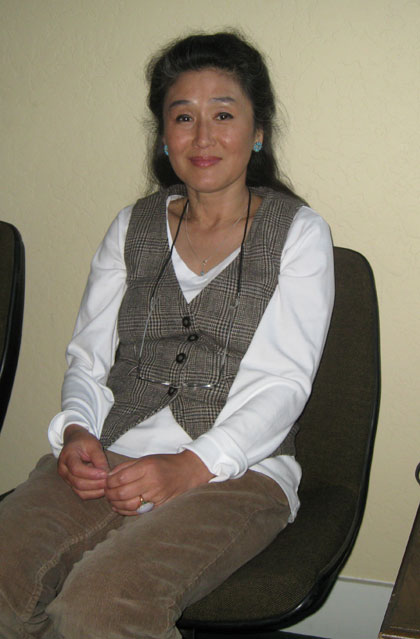
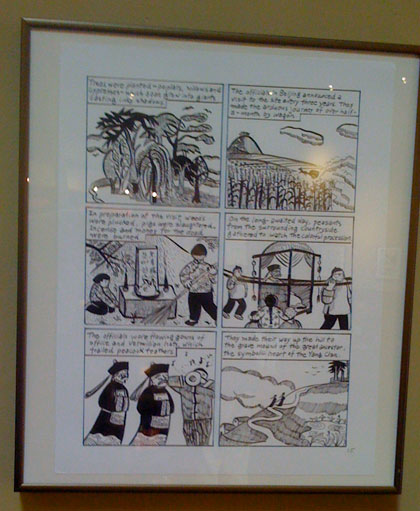
I had Belle Yang in the studio at KUSP at 7 PM on a dark autumn evening for Talk of the Bay. We had the studio and the station to ourselves for an hour, and we needed every minute. There was a lot to talk about with regards to her graphic memoir, 'Forget Sorrow.' The book in my hands was a remarkably complex construction in terms of story and art.
Belle Yang has lived through some pretty serious history herself. From the tales of her stalker through the Tiananmen Square Massacre, her own story is the stuff of myth. So her choice to tell her father's and grandfather's story — against the backdrop of a China that no longer exists and is pretty tough to wrap your brain around here in 21st century America — is quite brave. But that's just the beginning.
Now, I've talked with a lot of writers about their process and there are as many answers to this as there are writers. And of course, I talked with Yang about writing the book. But there was so much more than just writing, and that was something I've never had the opportunity to talk about. I was really curious about how you revise a graphic novel? I could imagine how painful that could be.
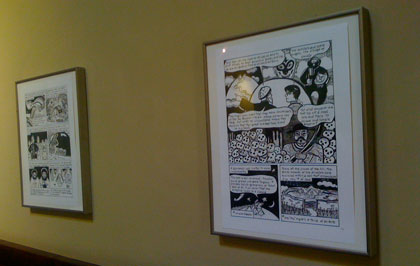
Yang's artwork is currently on display at the Museum of Art and History in downtown Santa Cruz, so went there to take a look at the pieces hanging on the wall, as opposed to paging through the book. It's quite a different experience. She talked about creating the larger work in our conversation, and the differences how the differences in scale affected her vision. You can find out by following this link to the MP3 audio file of our conversation.
10-21-10:A 2010 Interview with Charles Yu
"I really was searching for a frame, a different vocabulary to talk about what I hope are pretty universal emotions."
—Charles Yu
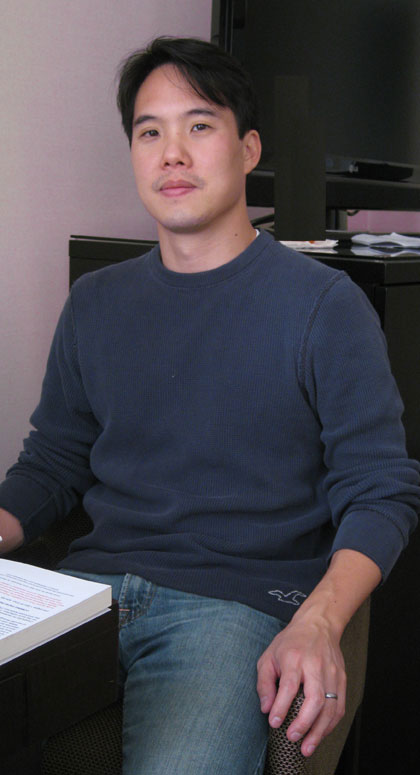
You won't be in a room with Charles Yu for very long without becoming acutely aware of time. Not just of time passing, but of time itself as an artifact. The more you try not to think of time, the more temporal your perceptions will become. Simultaneously — see, more time jargon! — you'll realize that you are in the company of a very clever literary theorist and writer.
Charles Yu is not your typical science fiction writer; in fact, you might argue that he is not a science fiction writer at all. But then, you'd get into his other forte, language, and you'd find that he does know and think a lot about language and narrative. Yu is clearly still in the early stages of his trailblazing, but his trail is already blazing quite brightly.
As i talked with Yu, I realized that I as a reader and an interviewer was in a rather unique position. Most writers produce writing that is divorced to a large degree from their lives, even if that writing is an intimate memoir. But with Yu, as a reader and as a listened, you will quickly learn that Yu's work, and speaking with him as well, are all parts of his journey. Yu is using language — and even conversation — as a sort of shoulder-mounted mini-camera. His novel is a streaming narrative that is as intricately braided as memory. You can enter our conversational maze by following this link to the MP3 audio file.
10-20-10:The Agony Column Live, October 9, 2010: Panel Discussion
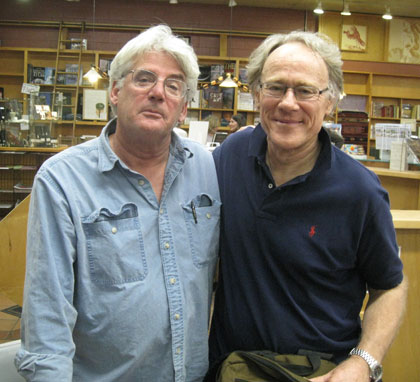
Jim Nisbet, Graham Hancock and Rick Kleffel
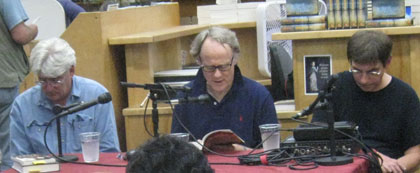
The readings were the easy part, and to be quite honest, while I suggested that Graham read the hair-raising bit that he did read — and warned me about — well, I was not without some regrets while he did so. But to me the passage did really lay out a lot of the basics of Graham's book including the fact that it is sort of hair-raising. Still, I knew that was the easy part. The hard part would be keeping the conversation between Hancock and Nisbet on some sort of track — or so I thought. Actually, once we got past the readings, things went remarkably smoothly. Not that I can broadcast much of this on the radio. And that's what makes it so much fun to listen to.
As I expected, these two writers did have more in common than either one of them might have surmised. But to my surprise, it was their differences that made the whole show so exciting, particularly as each talked of his past and the influence it had on him. Graham came from a newsman background, while Nisbet's experience of the news involved shotguns and televisions.
We had a great house for the second Agony Column live show with Graham Hanock and Jim Nisbet. I must admit that I was uncertain as to how this particular chemistry experiment would work. Hancock is well-known for his outsider archaeological writings, which include his latest work of non-fiction, 'Supernatural.' Nisbet is well-known for his outsider mystery fiction, which in fact often wanders right out of that genre and into a no-man's land inhabited only by Nisbet himself.
But Hancock is now writing fantasy fiction in 'Entangled,' finding, not surprisingly, that truth is more easily dispensed via fantasy than fact, while Nisbet's latest, 'Windward Passsage,' starts in a world more bizarre than most science fiction and ends up with a present that, while recognizable in every detail as the present, seems like science fiction.
And all that is just the readings, just the preliminaries.
I've split this Agony Column Live podcast into two portions. The first is a recording of both readings, and runs just around half an hour. You'll get a real flavor of the show itself and of both writers' styles. Tomorrow, I'll podcast the panel discussion.
This is a warning for all sensitive listeners. Both pieces are strictly for adults. Graham reads a passage from 'Entangled' that includes scenes with explicit and potentially upsetting sexual content. It is not for children, period. It's gripping and intense though, and gives a flavor of the book in terms of Hancock's style. Nisbet's reading is equally adult, though his prose style could not be more different. He reads from both 'Windward Passage' and 'Lethal Injection.' Let me re-iterate my warning: by following this link to the MP3 audio file, you are getting yourself in over your head, whether you expect so or not.
10-18-10:A 2010 Interview with Karen Joy Fowler
"I began to see what I wanted from stories, what was important to me in stories..."
—Karen Joy Fowler
Writers tend to have a sort of teaching gene. That's not especially surprising, since the compulsion to write is at its essence a compulsion to convey new information to an unseen audience. But Karen Joy Fowler seems to have more of this gene than the usual writer. Or perhaps it's just that I'm interested in how she creates her fiction. In any event, there are a lot of parts of our conversation about 'What I Didn't See' that are perfect fodder for writing workshops.
Of course, yes, we talked a lot about writing workshops up in the manager's office at Bookshop Santa Cruz. It turned out to be a great setting for an interview. It was quiet once I unplugged the phone, and the sound was excellent. One of the things I most enjoy about talking to writers is how often they surprise me. There are some who suggest that you should never ask a question to which you do not know the answer. But I find myself shocked early and often when I speak with writers, and Fowler was no exception.
Generally, the questions to which you get the most surprising answers are the ones you think are "safe." If you feel comfortable asking a question then there's a good chance that answer is not going to be what expect. So when I asked Fowler about how much she has to cut out of her stories, I felt I was on solid ground. Of course, I was thinking, all these stories start out much longer, and then get whittled down to the sparse and intense final versions we get to read.
08-21-15: Agony Column Podcast News Report : Senator Claire McCaskill is 'Plenty Ladylike' : Internalizing Determination to Overcome Sexism [Incudes Time to Read EP 211: Claire McCaskill, Plenty Ladylike, plus A 2015 Interview with Senator Claire McCaskill]
Agony Column Podcast News Report : Emily Schultz Unleashes 'The Blondes' : A Cure by Color [Incudes Time to Read EP 210: Emily Schultz, The Blondes, plus A 2015 Interview with Emily Schultz]
07-05-15: Commentary : Dr. Michael Gazzaniga Tells Tales from Both Sides of the Brain : A Life in Neuroscience Reveals the Life of Science
Agony Column Podcast News Report : A 2015 Interview with Michael Gazzaniga : "We made the first observation and BAM there was the disconnection effect..."
04-21-15: Commentary : Kazuo Ishiguro Unearths 'The Buried Giant' : The Mist of Myth and Memory
Agony Column Podcast News Report : A 2015 Interview with Kazuo Ishiguro : ".... by the time I was writing this novel, the lines between what was fantasy and what was real had blurred for me..."
Agony Column Podcast News Report : A 2015 Interview with Marc Goodman : "...every physical object around us is being transformed, one way or another, into an information technology..."
Agony Column Podcast News Report UPDATE: Time to Read Episode 199: Marc Goodman : Future Crimes: Everything Is Connected, Everyone Is Vulnerable and What We Can Do About It