|
 |
 Charlie Huston
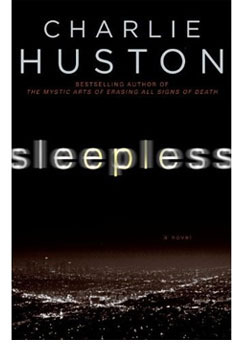
Sleepless
Reviewed by: Rick Kleffel © 2010
Ballantine / Doubleday / Random House
US Hardcover First Edition
ISBN 978-0-345-50113-4
Publication Date: 01-11-2010
368 Pages; $25.00
Date Reviewed: 01-26-2010
Index:
Science Fiction
Mystery
General Fiction
The things that matter most to us in this world are so fragile, so imperiled by the events that swirl around us that we must care — we must act. When you become a parent, you truly become a citizen of the world. Gazing at that little life, which you created, you know you must protect it with every ounce of life in you from the world that surrounds both of you. And you can't help but feel a little bit guilty about the state of things. That life, that baby was brought into a world you helped create. Maybe you should have done something different. Maybe you can still do something different.
Charlie Huston has written novels in a variety of styles. The Henry Thompson stories are hyper-violent tales of gritty, real-world revenge. The Joe Pitt casebooks manage the difficult feat of being even more violent, more profane, and grittier all with the addition of the fantastical element of vampires — Charlie Huston style, of course. 'The Shotgun Rule' cuts pretty close to the bone for Huston. It's set in his old stomping grounds, at the time when he was stomping (or getting stomped on.) But to my mind, his latest, the surreal, virtual-reality, dystopian apocalyptic novel, 'Sleepless' is his most personal novel. There's a lot of raw soul here rubbed up against the increasingly awful present, even if the book is set in the future. 'Sleepless' is one of those science fiction novels where the future gets to do double duty, where our world, so confusing, so chaotic, blends into our nightmares. So, yes, 'Sleepless' is in a sense a horror novel as well.
All this is outside the book itself, which is written as a sophisticated and gritty near-future noir. Parker Haas is an undercover cop who is working as a drug dealer, looking for a connection to the lucrative trade in Dreemer. Dreemer will not cure, but can offer relief for the sleepless, those who have contracted a prion disease that results in fatal insomnia. (It's based on a real disease.) We meet Parker in third-person narration, and in his first-person journals. Parker's wife is sleepless, and his newborn baby may be as well. We also meet an unnamed (at first) narrator, who, in the first person, seems to be looking for something related to Parker's search. How these two characters are connected and how the three narratives will come together becomes a very intense plot driver for this immersive, engaging novel.
Huston has a real knack for creating a realistic noir future that's not like much else out there. He uses the science fiction tropes well, world-building with restrained skill and a very fierce imagination. His setting is of the "day after tomorrow" variety, and he handles the imaginative and speculative writing with consummate ease. He knows just how much detail to place to create a vivid, dystopian Los Angeles that has pretty much lapsed into anarchy, but just doesn't know this yet. The jagged edges of the tripartite narrative overlap and as well leave gaps that are all-too-easily filled by the reader's imagination.
The narrative style also works both in terms of creating vivid characters and driving the plot. Parker is on the edge of agony; his wife, whom he loves deeply is going to die. He cannot protect either his wife or his child — but he can make some arrests. Huston does a superb job with Parker. You believe and feel his terror and helplessness in the face of a world coming apart at the seams. The emotions are raw, real and authentically affecting. There is humor in here as well, but it's pretty dark.
The unnamed narrator is equally well-drawn, but he's polar opposite of Parker. This is a man who moves with ease through the chaos, a man with no attachments but a strong sense of morals. As his path begins to track Parker's, we come to understand more and more their connections. He's a great character that makes the novel quite compelling, and a perfect execution so far as the mystery genre is concerned.
The prose in 'Sleepless' cuts way back on Huston's usual invective-laced humor, but there are still some nice turns of phrase in this regard. Huston's work here is really quite different from his previous work, though. This book has a bit denser feel to it, while maintaining the pulse-pounding nature of all of Huston's oeuvre. It's not self-consciously literary, but I'm quite certain that readers of literary fiction will find it rich and satisfying. There is a lot of pulse-pounding tension and violence. But it's filtered through the perceptions of a father grieving for his wife and child even though neither is dead — yet.
'Sleepless' is certainly Huston's most personal work to date. You can feel the new-fatherhood terror — the terror of bringing a child into a world that seems to be tearing itself apart — keenly. I would recommend that readers go into the book with no more information than I've imparted with this review. The less you know about 'Sleepless,' the better. The novel will indeed leave you sleepless, not just because it keeps you up all night trying to find out how the narratives come together, but as well, because Huston's vision is every bit as infectiously overwhelming as the prion disease he creates.
|
|
|
|
|
|
|
Review Archive
All Reviews alphabetized by author.
General Fiction
Non-Genre, general fiction and literature.
Horror
Supernatural fiction, supernatural horror and non-supernatural horror.
Science Fiction
Science fiction, science fantasy, speculative fiction, alternate history.
Fantasy
Fantasy, surrealism and magic realism.
Mystery
Crime, thrillers, mystery, suspense.
Non-Fiction
Non-Fiction, True Crime, Forteana, Reference.
Poetry
|
|
|
|